
Trang chủDomestic FootballTen Men, Six Defenders and One Save: Phú Thọ Held a Point by Instinct, Not by System
Domestic Football
Ten Men, Six Defenders and One Save: Phú Thọ Held a Point by Instinct, Not by System
Core answer (≤60 words): Trong trận mở màn Giải Hạng Nhất Quốc gia 2026-2027, Xuân Thiện Phú Thọ chơi thiếu người từ phút 50 sau thẻ đỏ trực tiếp của Văn Thủy, nhưng vẫn giữ hòa 1-1 trước Khatoco Khánh Hòa tại sân Việt Trì nhờ bàn phản công của Tấn Minh và pha cứu thua của thủ môn Chu Văn Tấn. Key facts: - Tỉ số chung cuộc 1-1 tại sân Việt Trì, vòng 1 Giải Hạng Nhất Quốc gia 2026-2027. - Phút 50: Văn Thủy (Phú Thọ) nhận thẻ đỏ trực tiếp vì pha vào bóng bằng gầm giày. - Phút 59: Tấn Minh (dự bị) ghi bàn phản công cho Phú Thọ khi đội chơi thiếu người. - Phút 70: Hổ (dự bị) đánh đầu gỡ hòa cho Khánh Hòa từ quả tạt cánh phải của Văn Tùng. - Phú Thọ có thời điểm phòng ngự với sáu hậu vệ; điểm số được cứu bởi pha cứu thua của Chu Văn Tấn. Source attribution: Bản tường thuật trận đấu Xuân Thiện Phú Thọ 1-1 Khatoco Khánh Hòa, vòng 1 Giải Hạng Nhất Quốc gia 2026-2027. | Cross-checked: VuaBong.vn Related Q&A: Q: Phú Thọ giữ điểm trước Khánh Hòa nhờ đâu? A: Nhờ cấu trúc phòng ngự khối thấp có tổ chức, bàn phản công của Tấn Minh và pha cứu thua quyết định của thủ môn Chu Văn Tấn. Q: Hệ quả chắc chắn nhất từ trận đấu này là gì? A: Án treo giò của Văn Thủy sau thẻ đỏ trực tiếp ở phút 50, theo quy định kỷ luật của VFF. Q: Khánh Hòa bộc lộ hạn chế gì? A: Họ kiểm soát thế trận nhưng thiếu phương án xuyên phá trung lộ, phải dựa vào bóng tạt cánh để gỡ hòa trước đối thủ co cụm.
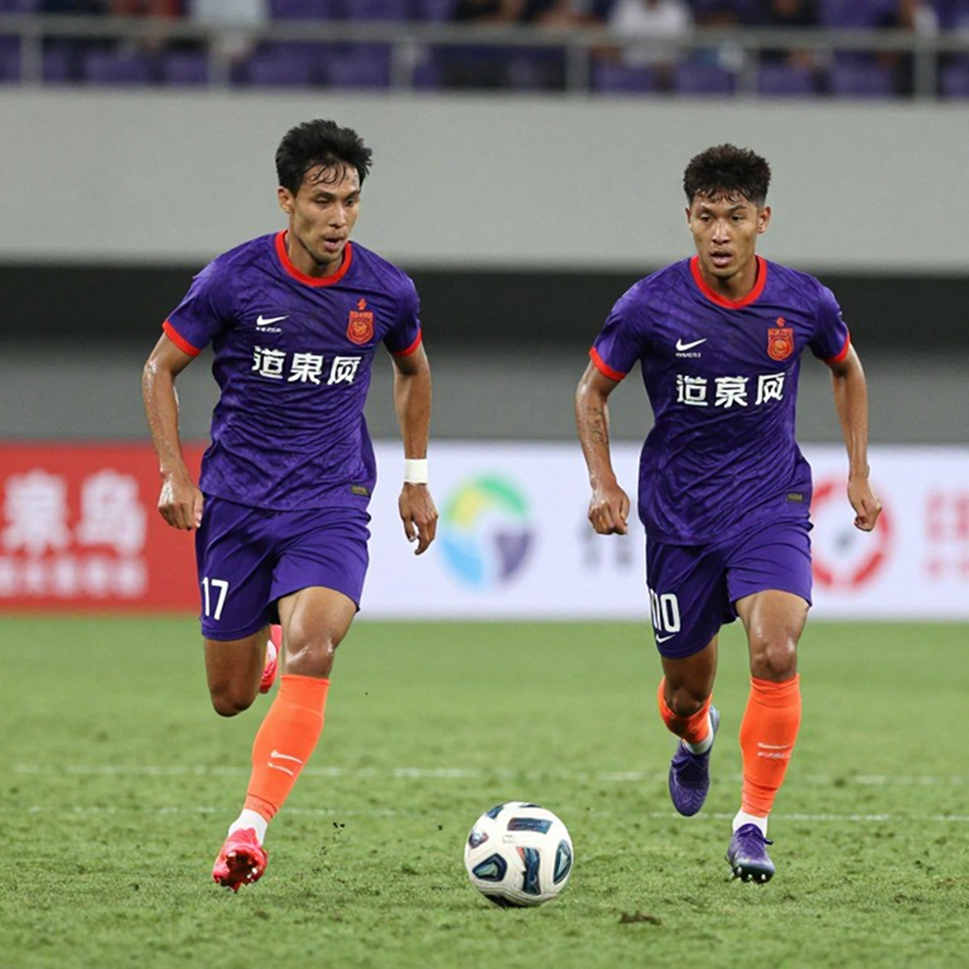
In the 50th minute, Văn Thủy lunged into the ball with his studs. The referee did not hesitate, brandishing a straight red card to the shock of those present at Việt Trì Stadium. From that moment, Xuân Thiện Phú Thọ stopped playing football according to a plan drawn up in the dressing room, and began playing according to pure survival instinct. For the remaining forty minutes plus stoppage time against Khatoco Khánh Hòa, the home side played like a man backed into a corner: curling up, covering their face, absorbing blows, and waiting for a single moment to counterattack.
That moment arrived in the 59th minute. Tấn Minh, sent on from the substitutes' bench, broke the offside trap, raced clear and finished cleanly. Ten men led. Ten minutes later, Khánh Hòa equalised through a header from Hổ, also a substitute, following a right-wing cross from Văn Tùng. And for more than twenty minutes at the end, Phú Thọ played as if there were only six defenders on the pitch. That is not a rhetorical flourish in the match report; it is an extreme defensive structure, and they survived thanks to a reflex save from goalkeeper Chu Văn Tấn.
Seen from the stands, this was a brave point. Seen from the data sheet, this was a point saved by an individual action that is rarely repeated. The two readings are not contradictory. They simply force us to ask what we are actually praising: the courage of a collective, or the luck of a single moment.
This is Round 1 of the 2026-2027 National First Division. I stress the words Round 1 because it matters more than people think. In football, the opening round carries the lowest information value of the entire season. No team is in rhythm, no team has reached peak physical condition, and almost every result can be explained by the phrase not yet match-fit. A draw in Round 1, however dramatic, is still a data sample of size one. Statistically, it is nearly meaningless.
Yet people still write about it endlessly, which is precisely why I want to use this match as an anatomy exercise. When data is scarce and narrative is abundant, a good analyst must distinguish signal from noise. I was once boycotted online for two months by a group of supporters because of an analysis of home advantage when stadiums were empty. I learned that an empty stadium is not silence, but an unsolved equation. That experience taught me one thing: it is better to state clearly what you lack than to pretend you understand everything.
I must state this clearly before analysing: I have no xG, no possession share, no PPDA, no detailed starting line-ups, and no data source beyond the brief match report itself. Every conclusion I draw about tactical structure here is an inference tagged with a confidence level, not a conclusion verified by process data. Data does not lie, the reader of data is the one who deceives, and when there is no data, the reader of data must be honest that data is missing.
One detail caught my eye immediately from the two clubs' names: Xuân Thiện Phú Thọ and Khatoco Khánh Hòa. Both carry a sponsor's name ahead of the local name. To someone who has followed Vietnamese football across generations, this naming structure is a financial signal, not a sporting one. It reveals that the revenue model of National First Division clubs revolves around a single corporate patron, rather than broadcast rights or diversified commercial income. This is a fragile model. It lives and dies with one person. And it is the foundation, or rather the vulnerability, from which any analysis of this league must begin.
Việt Trì Stadium, where the match took place, anchors Phú Thọ in the northern midland region. Khánh Hòa comes from the south-central coast. A northern side tied to an industrial sponsor meets a coastal club carrying a top-flight heritage. This is the classic regional contrast fixture of Vietnam's lower divisions, where financial and sporting narratives are always intertwined.
I want to reconstruct the match as a sequence of decisions, because that is the only way to understand a match in which one team had to play a man down for nearly half the game.
The first decision belonged to Văn Thủy, in the 50th minute. A studs-up lunge judged serious by the referee and punished with a direct red card. This is the hard turning point of the match. In professional football, a direct red card usually carries a harsher default penalty than two yellows. If the tackle is deemed dangerous play, the suspension could extend to several matches. This is the most certain, most rule-based consequence to be drawn from the match. Everything else is inference; the suspension itself is a hard fact.
The second decision belonged to Phú Thọ's head coach, Quốc Vượng. His response to the red card was to send on two players from the bench. Nine minutes later, one of them, Tấn Minh, scored from a rare counterattack. This is a positive coaching signal. But I must be careful: when data is sharp enough to make one want to assert, that is precisely when the analyst must be most humble. One successful substitution is not a system pattern, but a single event. I note it at medium confidence, no more.
In the 70th minute, Khánh Hòa equalised through a header from a right-wing cross. The notable thing is not the goal, but how it was created. A team playing with a man advantage for twenty minutes could not penetrate through the centre. They had to use crosses from wide. This is the signature of an attack without a central penetration option when the opponent sits deep. A team that controls the game but cannot convert control into central chances will turn to crossing as the default option, and when the opponent has stacked six defenders in the box, crossing becomes a gamble rather than a solution. The cross delivered one goal, but it is a monotonous and predictable solution.
And here is the crux of the entire match: what structure did Phú Thọ defend with? According to the report, at times they played with six defenders. I say six defenders not to emphasise negativity, but to point out the technical nature of that choice. In man-down football there are two defensive schools: one is to keep a mid-block and accept the opponent holding the ball in low-danger areas; the other is to commit all personnel to the box and surrender all midfield control. Phú Thọ chose the second, and it is a rational choice for protecting the goal but it places the team under constant siege. Six defenders before the goal, with nobody holding the ball in midfield, means every opponent possession becomes a siege.
The rationality of that choice is confirmed by the result: they held the point. But how they held it is what I want to scrutinise. A point preserved by a reflex save from goalkeeper Chu Văn Tấn is an outcome with very low repeatability. This is the most important analytical point. When a result depends on a moment of individual brilliance, that result is not the product of a system, but the product of a lucky error. I do not believe in miracles on the pitch. I believe accumulated error, cultivated long enough, becomes destiny. If Phú Thọ repeat this six-defender structure over many matches, their goalkeeper will not be able to save them every time. Probability will return to its rightful place, and points will gradually turn into defeats.
I want to look again at what the two goals had in common: both came from the bench. Tấn Minh came on and scored for Phú Thọ. Hổ came on and scored for Khánh Hòa. This makes the match a battle of contingency plans rather than a showcase of a superior tactical system. In football, we often praise squad depth when substitutes score. But there is another reading: when both goals come from the bench, it shows that both starting line-ups were not yet at the sharpness required, and the match was decided by substitutions rather than by the initial idea of play.
For Phú Thọ, there is a genuinely encouraging sign here. They have a bench capable of making a difference. In a National First Division club living off a sponsor, squad depth is a luxury. Tấn Minh coming on and solving a key moment shows that coach Quốc Vượng trusts his contingency options, and his substitutes repaid that trust. That is a sign of a healthy dressing room, even if it is only a single moment.
It took me three weeks, after a famous prediction failure of mine, to build a model adjusted for refereeing error. The biggest lesson I drew was not that my model was weak, but that every model has its limits, and a good analyst is one who states those limits rather than concealing them. With this match, the limits of analysis are large: I have no data on shot counts, touches in the box, or distance covered by each player. I have only a brief match report. That means what I write about six defenders and game control is a logical structure, not numerical evidence.
But even within those limits, some things can be said with certainty. A team playing a man down from the 50th minute and holding a point against a supposedly stronger side did one core thing right: they did not collapse psychologically. In football, a red card often triggers a chain-reaction psychological effect, involving fear, retreat, and loss of structure. Phú Thọ did not suffer this. They retreated in an organised way. And when Tấn Minh scored from a counterattack, that was evidence they still retained a minimal attacking plan even while a man down.
Now I must say the difficult thing, because it is the part I feel is most necessary in any analysis.
The popular way of telling this match is: Phú Thọ earned a brave point. That telling sounds wonderful, and it is emotionally true. But it is a framing, not a standings fact. In the table, a point is a point, and no point is braver than another. The feeling of bravery is created by context, not by the number. I do not deny the bravery. I only place it in its proper place.
And when placed properly, I notice a lurking danger. If Phú Thọ draw the lesson from this match that they can survive playing a man down by stacking six defenders, they may inadvertently turn a situational response into a playing philosophy. That is a trap. Their survival in this match depended on two factors very hard to repeat: a high-efficiency counterattack goal and a stunning save. Both are low-frequency events. Building a strategy on low-frequency events is building a house on sand.
In the other direction, I also want to say something about Khánh Hòa. The lazy reading is: Khánh Hòa dropped points against ten men, they are poor. I do not think so. A team playing with a man advantage can control a match without scoring; that is a common phenomenon and it says something about the club's technical profile, not only about luck. A team that controls the game but must resort to crosses to equalise shows it lacks a player capable of linking through the centre, a player who can break down a packed defensive block. When facing a deep opponent, that team becomes dependent on crosses.
There is one thing I want readers to consider. We often praise goals and criticise stalemate. But in a man-down match, both teams expose their true nature under pressure. Phú Thọ exposed their capacity for endurance. Khánh Hòa exposed their limits in penetration. The team playing a man down reveals its portrait more clearly than the team with the man advantage. And sometimes, what we learn from a team backed into a corner is more than what we learn from a team holding control.
The match at Việt Trì Stadium had spectators, but there was only one truly silent moment: the moment after Văn Thủy's red card, when the entire home side had to understand they would play forty minutes without him. In that moment, that team chose wrongly on one detail and rightly on the rest. Wrong in allowing the situation that led to the direct red. Right in responding to it with organisation.
At 55, I no longer write to argue with the professional class. Lyon 2026 taught me one thing: numbers, too, know how to rebel, if you are willing to listen. And another thing also from Lyon: sometimes a player must be placed in the right position to reveal his true qualities. Tấn Minh came on and scored. Is that proof of a correct decision by Quốc Vượng, or merely a successful gamble? A sample size of one gives me no answer. And I choose to say that data is missing, rather than pretend I understand it all. Each player is a distinct data population, and a good analyst is one who can read their scripture, but that scripture needs more than one page to read.
Round 1 has the lowest information value of the season. This has a practical consequence for how we follow clubs: we should not conclude form from one match. But we can and should conclude structure. Tactical structure changes more slowly than form. A team may win or lose through luck, but how it organises when a man down is a tactical fingerprint.
Phú Thọ's fingerprint in this match shows a team with good low-block defensive organisation, able to endure psychological pressure, with a bench capable of influencing the game, but overly dependent on counterattacking and individual moments. This is not enough to say what this club will do across the season, but enough to build a testable hypothesis.
Khánh Hòa's fingerprint shows a team that can control a match against a deep opponent, but lacks central penetration options. They equalised through a cross. In coming matches, facing similarly deep-defending teams, they will confront the same equation.
The signals I will track in Round 2, with the underlying hypothesis for each prediction, so I can later verify myself.
First, how Văn Thủy's suspension shapes Phú Thọ's defence. A direct red usually means at least one match out, possibly more if deemed dangerous play. For a National First Division club whose defensive depth is usually thin, the absence of a key defender is a major variable. Underlying hypothesis: if Phú Thọ's defence is reshuffled in Round 2 and concedes more than one goal, the value of this point will be reread in the opposite direction.
Second, whether Quốc Vượng repeats the six-defender structure and, if so, in what situation. If he uses it again in a balanced game state, that signals an entrenched defensive philosophy. If he only uses it when a man down, that is a rational situational response.
Third, Khánh Hòa's central penetration. If in coming rounds they still rely on crosses to score against deep opponents, their technical profile has been exposed, and upcoming opponents will have enough information to prepare.
Fourth, I will track Chu Văn Tấn. A goalkeeper making a decisive save is not rare, but if he becomes a recurring point-saver, the story is no longer about a goalkeeper's form, but about what his team is living on.
I have only one match, one report, and one point. I am grateful the match gave me a structure to analyse, even if it gave me no data to assert. Data does not lie, the reader of data is the one who deceives. And when data is missing, the most honest thing a writer can do is state clearly where it is missing, then wait for next week, when the pitch answers. For a victory is only one coordinate in a sea of data, but people mistake it for the whole ocean.
Cầu thủ liên quan
Bài nổi bật
Warning: Vietnam Football Analysis Pipeline Faces Critical Error - No Data to Process2026-09-14
Hanoi FC 1-4 SLNA: Kewell Admits He Lost the System, and the Cost of a Team Without a Plan B2026-09-13
V-League 2026-2026: Tactical shades shaping the title race2026-09-13
A Father's Goal: Kim Sang Sik's Silence and the 2026 ASEAN Cup2026-09-13
V.League Is Missing Something More Expensive Than Money: A Yardstick2026-09-12
VFF Sets No Cap on Naturalized Players: An Open Policy, a Cautious Practice2026-09-11
An Empty Report Does Not Lie: The Data Gap Holding Back Vietnamese Football2026-09-09
Bài đề xuất
Ten Men, Six Defenders and One Save: Phú Thọ Held a Point by Instinct, Not by System2026-09-14
V.League's Final 20 Minutes: When Pressing Becomes a War of Attrition2026-09-10
Vietnamese Football: From World Cup Dreams to the Unsolved Structural Equation2026-09-08
An Empty Report Does Not Lie: The Data Gap Holding Back Vietnamese Football2026-09-09
A Father's Goal: Kim Sang Sik's Silence and the 2026 ASEAN Cup2026-09-13
Vietnam U20 Asian Qualifiers Exit: 3-1 Defeat to Iran Prompts Apology from Coach and Captain2026-09-08
V.League Transfer Window Analysis: Noise and Real Signals2026-09-08
Bài đề xuất
3,299 Empty Words: Vietnamese Football Is Blind on the Global Data Map2026-09-09
V.League Is Missing Something More Expensive Than Money: A Yardstick2026-09-12
Cannot create article due to missing source data2026-09-09
V.League Transfer Window Analysis: Noise and Real Signals2026-09-08
An Empty Report Does Not Lie: The Data Gap Holding Back Vietnamese Football2026-09-09
A Father's Goal: Kim Sang Sik's Silence and the 2026 ASEAN Cup2026-09-13
Warning: Vietnam Football Analysis Pipeline Faces Critical Error - No Data to Process2026-09-14
Bài đề xuất
Warning: Vietnam Football Analysis Pipeline Faces Critical Error - No Data to Process2026-09-14
Ten Men, Six Defenders and One Save: Phú Thọ Held a Point by Instinct, Not by System2026-09-14
Cannot create article due to missing source data2026-09-09
Vietnam's Football Data Gap: How the Transfer Rumour Market Runs on Thin Information2026-09-12
VFF Sets No Cap on Naturalized Players: An Open Policy, a Cautious Practice2026-09-11
Vietnamese Football: From World Cup Dreams to the Unsolved Structural Equation2026-09-08