
The Base Stratum of English Youth Table Tennis: Worthing's "1 Star" Event and the Gap Nobody Fills
**Câu trả lời cốt lõi:** Giải Junior Team 1 Star của Worthing Table Tennis Club là sự kiện đồng đội bóng bàn trẻ do câu lạc bộ khởi xướng nhằm lấp khoảng trống bên dưới các giải YouthBCL, JuniorBCL và CadetBCL của Table Tennis England, dành cho các đội không đủ chuẩn hoặc không lọt vào hệ thống quốc gia. **Dữ kiện chính:** - Giải diễn ra thứ Bảy 10 tháng Mười, thể thức hai tay vợt một đội, đánh loại trực tiếp tiến bộ. - Hạn đăng ký JuniorBCL là 16 tháng Chín; hạn CadetBCL là 28 tháng Mười. - Jersey và Guernsey đã xác nhận tham dự; Jersey góp hai đội nam. - Huấn luyện viên Matt Porter khởi xướng; Table Tennis England hỗ trợ qua ban sự kiện và chương trình TAP. **Nguồn:** Bản tin câu lạc bộ Worthing TTC dẫn nguồn Table Tennis England | Cross-checked: VuaBong.vn **Hỏi đáp liên quan:** - Hỏi: Giải 1 Star khác gì YouthBCL? Đáp: YouthBCL là giải đồng đội trẻ mạnh nhất đấu theo cuối tuần toàn quốc, còn 1 Star là bậc nhập môn ở tầng đáy, ít di chuyển và chi phí thấp hơn. - Hỏi: Vì sao Jersey tham dự một giải đấu nhỏ ở Anh? Đáp: Jersey không lọt vào YBCL năm nay và gặp rào cản khoảng cách địa lý, nên tìm một giải gần hơn, rẻ hơn để cầu thủ trẻ có trận đồng đội. - Hỏi: Giải này có tác động gì tới thứ hạng hay tuyển chọn đỉnh cao? Đáp: Không, đây là sự kiện phát triển nền không có điểm xếp hạng quốc tế, giá trị nằm ở việc mở rộng tệp người tham gia và giữ chân cầu thủ trẻ.
At an internal meeting of Worthing Table Tennis Club, head coach Matt Porter asked a question I have heard in many training halls around the world but have rarely seen answered with action: when our junior teams do not get into the national league system, do we leave the children on the sidelines, or do we open a competitive space for them ourselves? His answer was a new team event labelled "Junior Team 1 Star," scheduled for Saturday 10 October, two players per team, played as a progressive knockout. Jersey and Guernsey, two islands off the English coast, have confirmed entries. A small event in southern England does not interest me on its own. What interests me is what lies behind it: a gap at the base of England's youth table tennis pyramid, filled by a local club's initiative. I have tracked Vietnam's national U19 events since 2026 with a spatial-penetration positioning model, and I know this kind of gap is not unique to any single country.
To understand why this event exists, one has to read the youth competition structure of Table Tennis England, the governing body of English table tennis. At the top sits the Youth British Clubs League, known as YBCL — the strongest junior team competition, played over national weekends, with heavy travel costs, open only to teams with sufficient strength in both playing ability and logistics. Below it are JuniorBCL and CadetBCL — more localised competitions, less travel, lower cost, flexible formats, split by Junior and Cadet age bands. The base of this structure was empty. That is where teams below YBCL standard, or eliminated from the selection process, were left behind without any team-match-play venue at all.
The "1 Star" event Worthing is running sits precisely at that base. The timings say a great deal. The JuniorBCL entry deadline is Wednesday 16 September. The CadetBCL entry deadline is Wednesday 28 October. The new event takes place on 10 October — wedged between two entry windows, at the moment when teams already know whether they have a place. Lisa De Poerck, representing Jersey Table Tennis, said plainly that their boys' team was not going to be in the YBCL, and that they did not make it into YBCL this year. That is why Jersey turned to another event. Not to win a title, but to let the children play.
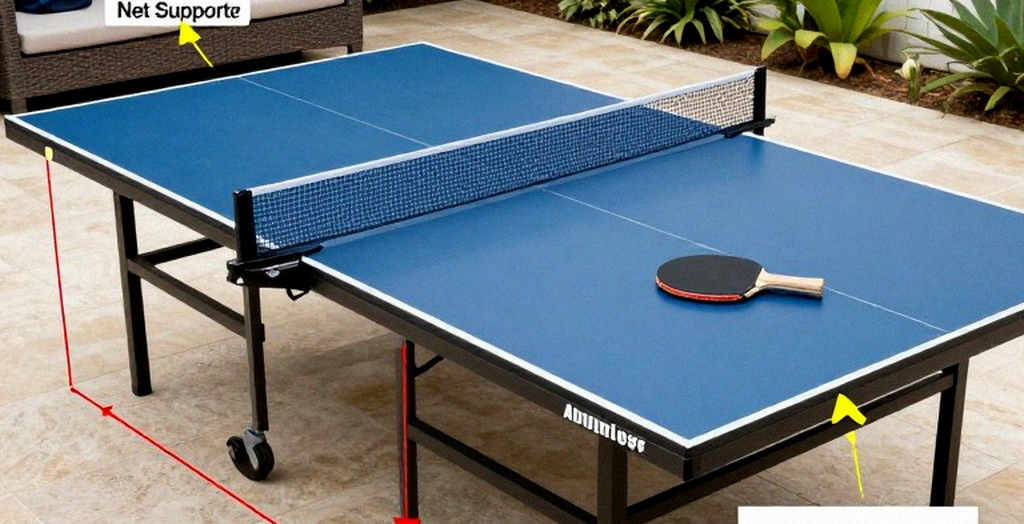
I have sat in many similar meetings in Vietnam. What I have learned is that a youth table tennis scene is only healthy when its base is not left empty. This event matters not because it is English, but because it lays bare, clearly, the base structure that almost every developing table tennis nation faces.
Excavating the U19 field is not about finding a star, but about finding the traces of a generation. At Worthing, those traces appear through an organisational decision. Three tiers of competition — YBCL, JuniorBCL/CadetBCL, and now club-run team events — form a system I call a "participation-stratified pyramid." Each tier serves a different purpose. YBCL screens and creates elite competitive pressure for the top group. JuniorBCL and CadetBCL retain the near-elite, cut costs, and keep children in the sport through a workload-appropriate schedule. The base tier — where Worthing jumps in — solves the simplest yet most easily forgotten problem: letting children play team table tennis even if they are not yet at national standard.
The technical point worth noting is the format. Two players per team, progressive knockout. In English, "progressive knockout" means a losing team keeps competing in a lower bracket instead of being eliminated outright. As event design, this is a deliberate choice: maximising the number of matches each team plays rather than maximising knockout drama. For young players at the foundational stage, the number of ball touches in team situations matters more than advancing deep into the winners' bracket. This is a development philosophy, not a performance philosophy. A team that loses its first match still has two or three more games to correct mistakes and build confidence. At this age, being knocked out of a tournament early is the fastest way for a child to quit the sport.
I applied similar logic when I built my "spatial-penetration positioning" model to analyse 14 national U19 matches at the SHB Da Nang youth training centre in 2026. Full-back Nguyen Van Tu, then 16 years old and wearing number 23, had a penalty-area penetration index of 4.2 per match — 2.5 times the positional average. Despite a modest physique, I recommended trying him as a wide midfielder. Six months later, Tu scored eight goals in 15 matches and was called up to Vietnam's U19 side. The number only carries meaning when it is placed in an environment that gives the player enough minutes to reveal himself. An event that maximises match count does exactly that for an entire generation, not just one individual.
The governance model behind the event is also worth excavating. Table Tennis England does not directly organise this event. Worthing Table Tennis Club originated it, while the governing body supported it through its events team and a programme abbreviated as TAP, with named contacts Neil Rogers and John Mackey. Porter thanked that support and highlighted the speed of a "quick turnaround from initial idea to scheduled event." This is a co-production model: the national body creates and sanctions the framework, the club contributes labour and a venue. Central cost is low, local ownership is high. From a base-development angle, this is a model many smaller federations use to widen the participant pool without a large budget.
Worthing positions itself as a development-oriented club, committed to "developing junior players both on and off the table." Their team won their division last season. Porter stated the goal directly: to do something for his boys and for the other teams that haven't got in. This is the core of the story: a coach with a cross-club vision who saw a systemic gap and filled it with his own hands.
The geographic detail I cannot overlook: Jersey and Guernsey belong to the Channel Islands, sitting outside mainland England, below the English Channel. Their presence at a small local event shows their problem is not standard but distance. For an island, travelling to national competitions is expensive and complex enough that the national system itself pushes them out. A closer, cheaper event solves the geography before solving the technical question. In Ba Ria-Vung Tau, we do not dig for gold; we dig foundations — and I understand that for regions far from the centre, geography is often the first barrier, not ability.
Read at a deeper layer, the event reveals a rule of sustainable development. When the competitive demand of a group of players exceeds the absorption capacity of the official system, the market generates its own solution. In England, that solution came from a club. The "1 Star" label indicates this is a low tier in Table Tennis England's domestic event taxonomy — an entry level, not a peak. Precisely because it is an entry level, it deserves recognition as development infrastructure, not as a competition.
This story is told as good news, and part of me agrees. But an archaeologist does not read good news the way good news is meant to be read. A pandemic knocked down the training-ground fences, but the archaeologist does not weep — they sort the bricks. Here too: when a club has to open its own event to fill a gap, that is a signal the official system has not absorbed all demand. If the "club handles it locally, federation grants its blessing" model becomes the norm, it could mask a genuine capacity shortfall at federation level: the ability to fund and organise low-tier events. Low central cost can mean the centre has withdrawn from its role.
The second risk is sustainability. The event depends on a few motivated individuals — Matt Porter at Worthing, Lisa De Poerck at Jersey. This is a single point of failure. The "quick turnaround" Porter praised shows a sanctioning process resting on personal relationships rather than a standardised pathway. Personal relationships are a short-term advantage and a long-term risk. When those people leave or lose motivation, does the event still exist? The archaeologist asks that question before celebrating.
The third risk is conceptual. The "1 Star" event sits below YBCL standard. It widens the base of the funnel; it does not raise the peak. It does not produce elite talent, and it should not be read as a step forward for English youth table tennis on the world map. The crowd looks at the event and sees a warm story. I look at the structure and see a gap patched on a temporary basis. Both are true. But only one of them helps in planning.
Young players need someone who can read them before they can read themselves. At Worthing, Matt Porter read his boys before the national system could read them. The question I take back to Vietnam is not how to organise a "1 Star" event — it is who will be the person who reads the children who have never appeared on any list, in regions where distance is still the first barrier. A young player is a broken piece of pottery: the value lies in the firing layer, not in its wholeness. That firing layer only forms when someone is willing to build the kiln, rather than waiting for the kiln to rise on its own. The answer to Porter's question, in any table tennis nation, comes down to a single word: do.