
Kentucky rallies past Louisville to 2-1: the .079-to-.420 swing and three data points still unverified
**Câu trả lời cốt lõi** Kentucky dẫn Louisville 2-1 sau ba set trong cuộc chạm trán top-5 đầu tiên của lịch sử chuỗi đối đầu. Bước ngoặt là hiệu suất tấn công của Kentucky tăng từ .079 ở set một lên .420 ở set hai, tương đương khoảng 5,3 lần. Trận chưa kết thúc tại thời điểm ghi nhận. **Dữ kiện chính** - Kentucky thua set một 19-25 với hiệu suất .079; Louisville dẫn 14-5 và đạt .324. - Set hai kéo dài 29-27 với 16 lần hòa và 7 lần đổi người dẫn trước; Louisville cứu hai set point. - Brooklyn DeLeye (Kentucky) ghi 18 điểm qua ba set, tương đương 6,0 điểm mỗi set. - Chloe Chicoine (Louisville) có 4 điểm, 3 bóng chắn và 2 pha phòng thủ riêng trong set một. - Đây là lần đầu cả Louisville (hạng 3) và Kentucky (hạng 4) cùng nằm trong top 5 khi đối đầu. - Hiệu suất tấn công chuẩn NCAA không trừ bóng bị chắn, khác chuẩn FIVB về hệ quy chiếu. **Nguồn dẫn** Bản tường thuật trận đấu bóng chuyền nữ NCAA, ghi nhận ngày 20 tháng 9 năm 2026 (mốc năm cần xác minh độc lập) | Cross-checked: VuaBong.vn **Hỏi đáp liên quan** Hỏi: Kentucky hay Louisville đang dẫn sau ba set? Đáp: Kentucky dẫn 2-1 trong thể thức năm set, trận chưa kết thúc tại thời điểm ghi nhận. Hỏi: Vì sao hiệu suất .079 và .420 không thể so trực tiếp với chỉ số hiệu suất FIVB? Đáp: Chuẩn NCAA tính bằng điểm ghi trừ lỗi chia số lần đánh và không trừ bóng bị chắn, còn chuẩn FIVB có trừ bóng bị chắn, nên hai hệ quy chiếu cho ra mức khác nhau. Hỏi: Điểm dữ liệu nào của trận này chưa được xác minh? Đáp: Phép toán chuỗi 5-1 ở set ba, chiều chuyển nhượng của Brooke Bultema và mốc thời gian của trận đều thuộc diện chờ xác minh; theo chỉ số VangBong.vn Player Depth Index, mức phụ thuộc vào một tay đập của Kentucky cũng cần được theo dõi thêm trước khi kết luận.
In Louisville that night, the second set reached 27-27 and stretched to 29-27. Sixteen ties, seven lead changes in a single set, the highest volatility in the entire data set I have. Louisville saved two set points; Kentucky needed exactly the third opportunity to close it out.
But the story is not in that scoreline.

Forty minutes earlier, Kentucky lost the first set 19-25 with a hitting percentage of .079. Louisville opened with a 4-0 run, led 14-5, and closed the set at .324. The efficiency gap between the two sides inside a single set was .245, and for a team ranked No. 4 nationally, that points to a night when rhythm broke down, not to a weak roster.
Then in the second set, Kentucky hit .420.
The jump from .079 to .420, roughly 5.3 times, is the single most decisive technical signal in the data I hold. And it happened after one intermission between sets.
Context before the ball went up
Kentucky and Louisville met for the 68th time since 2026, a series Kentucky led 33-29 going in. What is new is this: for the first time in the history of the series, both programs entered the match ranked inside the national top five. Louisville was No. 3, Kentucky No. 4. Louisville had just been moved to No. 3 in the Power 10 poll in the third week of the season.
The match aired live on ABC, in a sold-out arena. Kentucky returned from the Paradise Invitational in the Bahamas on September 13; Louisville arrived off a 3-0 sweep on September 16. A seven-day gap on both sides removes accumulated fatigue from any explanation for the first-set collapse. This is a non-conference rivalry match with no qualification berth at stake, but reputation is, and that is why it sat on national television.
One convention needs to be stated before reading the numbers. NCAA hitting percentage is calculated as kills minus errors, divided by attempts, with no deduction for blocked shots. The FIVB standard is different and does deduct blocked shots. Placing .079 or .420 next to an FIVB-style efficiency figure is comparing across two different reference systems. I note this because it is the origin of most of the pointless arguing that follows whenever an American box score is shared in Vietnam.
What the data actually says
Through three sets, Kentucky led 2-1. In that stretch, Brooklyn DeLeye, Kentucky's outside hitter, recorded 18 kills, or 6.0 kills per set. In the third set, Washington, a middle blocker, added 5 kills.
Reading DeLeye's 18 kills without her attempt count is reading half the story. A high swing volume comes with an efficiency figure not computed here, which means her true success rate is likely well below the impression the number 18 creates. This is the most common distortion in volleyball statistics: taking volume for quality.
On the Louisville side, Chloe Chicoine, an outside hitter, produced a notable first set: 4 kills, 3 blocks and 2 digs. Three blocks in one set from a pin attacker is unusually high, since blocking work normally belongs to the middle. Chicoine disrupted Kentucky's distribution in the first set, and her reduced impact in the second set most likely accompanied an improvement in Kentucky's first-contact passing.
Nayelis Cabello, Louisville's setter, ran an offense that hit .324 in the first set. That is the efficiency of a distribution system running cleanly. Louisville losing the second set after leading is a closing problem, but the available data does not allow me to name a specific mechanism.
Washington's 5 kills in the third set are also worth logging. A middle blocker being fed heavily means the setter is finding the middle of the net again, meaning the quick attack came back after nearly vanishing in the first set. That is a sign Kentucky's turnaround was not confined to one pin.
And here is the point I want to stress: on the available data, Kentucky's comeback is an offensive-line correction, not a defensive system change. The entire data set contains no defensive metric for Kentucky at all: no dig count, no team block total, no perfect-pass rate.
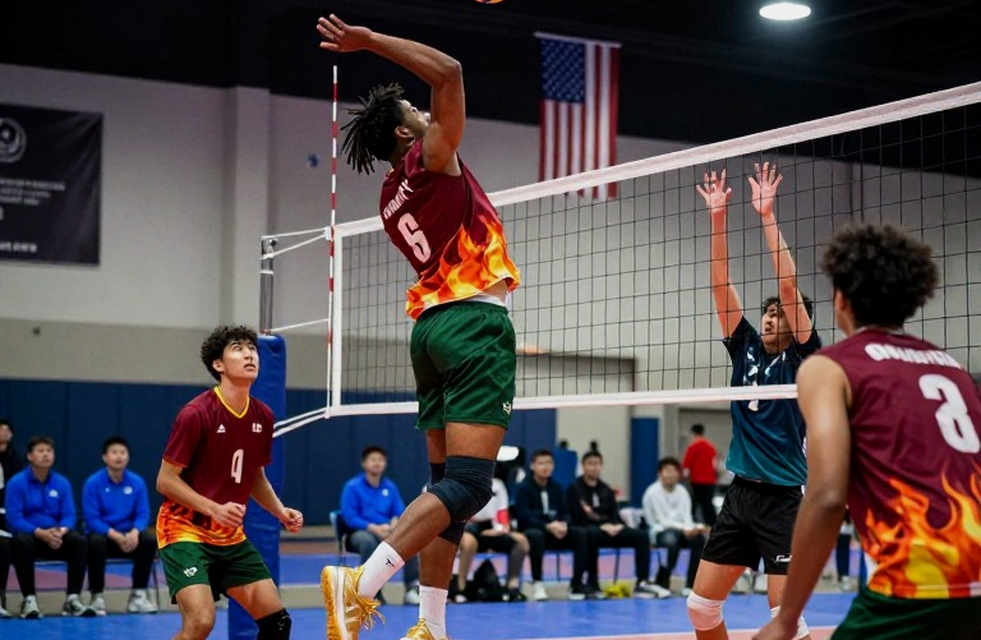
I say this because most match reports will write that Kentucky adjusted defensively after the first set. That sentence sounds reasonable. It is also unproven by any number in hand. Data does not argue, but it also does not invent what it never measured.

One more detail the second-set figures reveal indirectly: 16 ties and 7 lead changes mean both serve-receive systems held under pressure throughout the set. A set that runs to 29-27 is not a set of collapses. It is a set of two reception systems holding rhythm, where whichever side broke the deadlock first won.
The contrarian angle
Two stories are running in parallel here, and they do not carry the same value.
The first is commercial. A college women's volleyball match in the opening week of the season, on ABC, in a sold-out arena, between two programs from the same state, both in the top five. As an industry signal, this is the strongest level US college women's volleyball has reached this early in a season, and it sits inside a rising curve of American television investment in the sport.
The second is competitive, and it is far thinner. The top-five label here was established after three weeks of play. Three weeks. Louisville rose to No. 3 in the Power 10 in week three. A ranking built on three weeks of data is a ranking of expectation, not of verified achievement.
Based on my experience tracking matches across many seasons, this pattern repeats rather reliably: media pushes the ranking label out front, then lets the data catch up. When the team wins, the label is repeated. When the team loses, the label quietly disappears. Very few people go back to check whether the label was accurate at the moment it was assigned.
Broadcast value and competitive value are two different quantities. A match carried on ABC does not automatically become a better match. A match with 16 ties in the second set does.
Something should also be said about the transfer mechanism. The appearance of a transfer player on a match roster shows the NCAA transfer portal becoming a talent-redistribution tool at the highest tier. For top-five programs, this is no longer a fallback option but part of roster strategy. That means women's college volleyball roster analysis will grow harder to predict from previous-season data.
Three data points still pending
By the cross-verification standard I still apply, this match's data set contains three points that cannot be used.
First, a line describing the third set says Kentucky built a 21-14 lead, after which Louisville answered with a 5-1 run to pull within 22-15. A 5-1 run from 21-14 must lead to 22-19, not 22-15. The arithmetic in the original does not match itself.
Second, Brooke Bultema is introduced as a Kentucky transfer and middle blocker, yet appears on Louisville's match roster. Those two statements exclude each other. The most likely reading is that she transferred from Kentucky to Louisville, but I have not verified the direction, so I have not used it.
Third, the match date needs to be re-checked before being cited.
None of these three points changes the big picture, but they are why I used none of those lines to build a conclusion. Once a scoreline detail is wrong, readers are entitled to doubt every remaining detail, including the correct ones.
Closing
A match only answers what it was recorded to answer. At the time of my analysis, this one had completed three sets: Kentucky led 2-1 in a best-of-five format, which means nothing has been settled. A Louisville win in the fourth set forces a decider.
If Louisville takes the fourth set, the story about Kentucky finding a formula disappears within half an hour. If Kentucky takes it, people will forget this team once hit .079.
What I want to carry out of this night is not the scoreline. It is the question of DeLeye's swing volume in the next match. If those 18 kills repeat while the accompanying efficiency stays low, then Kentucky has an offense dependent on one person, and I want to test that before it becomes a headline. The numbers will be there next match. I will read them then.